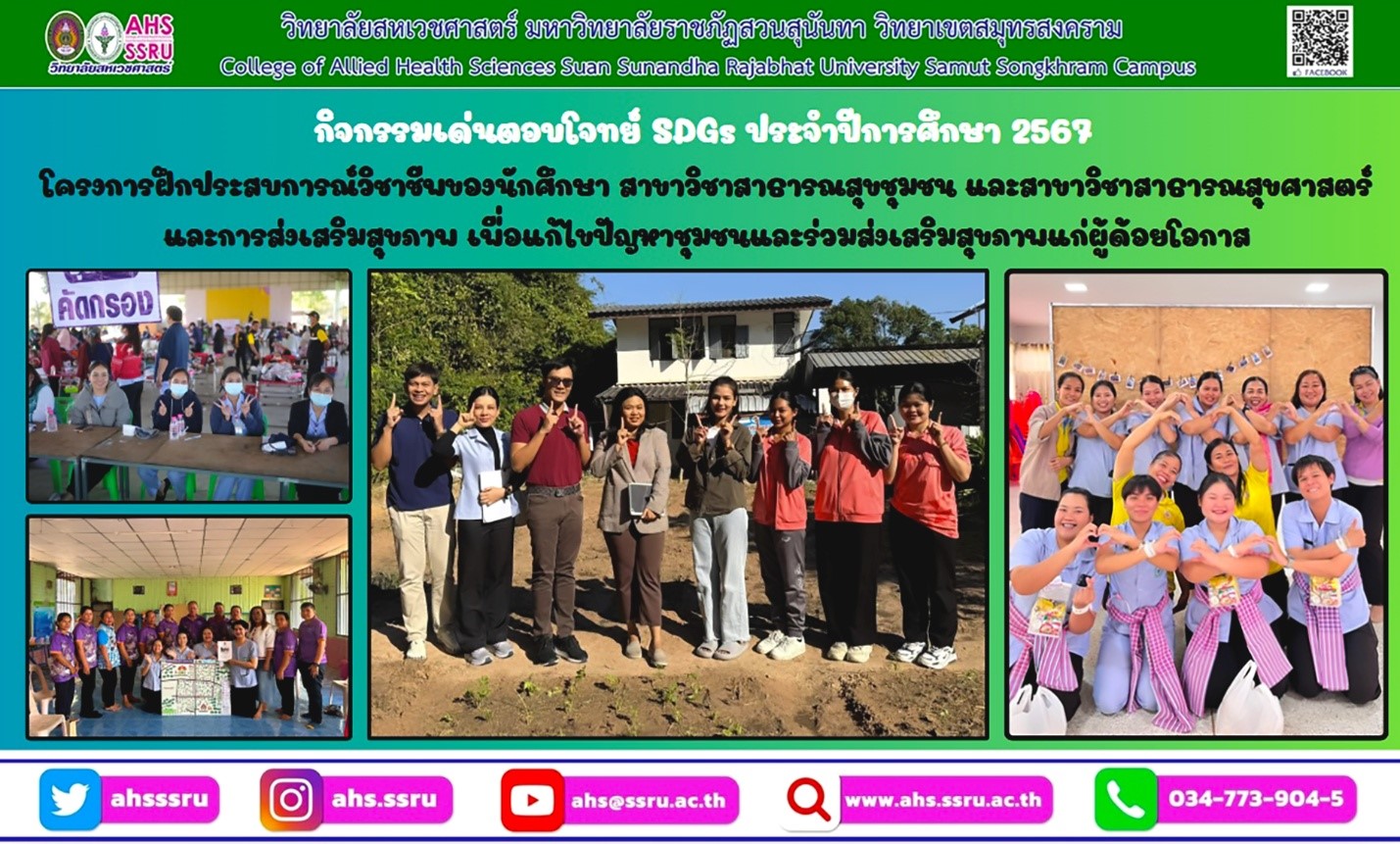
Professional Practicum
Program for Students from Two Majors:
Community Public Health and Public
Health and Health Promotion, Aiming to
Address Community Health Issues and
Promote Well-Being Among Underserved
Populations The
professional practicum program for
undergraduate students in Community
Public Health and Public Health and
Health Promotion is designed to develop
students' professional competencies
through field-based experience in real
community settings. The program is
implemented under the framework of the
United Nations Sustainable Development
Goals (SDGs), particularly SDG Goal 3:
Good Health and
Well-Being. Throughout the
program, students engaged in fieldwork
in collaboration with local public
health agencies, including Subdistrict
Health Promoting Hospitals (SHPH),
Subdistrict Administrative Organizations
(SAO), and networks of Village Health
Volunteers (VHVs). Key responsibilities
included conducting community health
surveys, assessing risk factors in
target populations, organizing health
promotion activities, performing
preliminary health screenings, and
visiting bedridden or homebound patients
with limited access to formal healthcare
services. In addition to fieldwork,
students practiced problem analysis
based on community health data and were
encouraged to propose context-specific
interventions. These included designing
targeted health promotion programs,
developing health education materials,
and launching advocacy campaigns on
issues such as non-communicable diseases
(NCDs), malnutrition, mental stress, or
vaccine accessibility among vulnerable
populations. The program emphasized a
participatory approach that engaged
community members throughout all stages
of implementation. The objectives
of this practicum program are: 1.
To provide students with real-world
professional experience in public health
practice. 2. To promote
preventive, community-based approaches
to addressing local health
issues. 3. To improve the quality
of life among underserved populations by
enhancing their access to appropriate
health knowledge and services. By taking on an active
role in community engagement and service
delivery, students not only developed
essential skills but also contributed
meaningfully to improving public health
outcomes in the target areas. This
program exemplifies how higher education
institutions can integrate academic
missions with global sustainable
development priorities—most
notably, by ensuring equitable and
sustainable health for all age groups in
Thailand, in alignment with SDG 3.